Cart
0
You may also like




Quick take: Halal isn’t just a religious checkbox. For modern, quality-conscious consumers, it’s a powerful quality system—one that touches animal welfare, ingredient integrity, purity, hygiene, and cross-contamination controls. Below, we break down how halal standards can benefit everyone and why they matter for halal protein, halal collagen, halal whey, and the broader world of halal supplements, Islamic supplements, halal fitness, and halal sports nutrition.
Most people hear “halal” and think “a religious rule about meat.” That’s true—but it’s incomplete. In practice, halal is a comprehensive integrity framework. It starts with lawful ingredients and extends across animal care, slaughter ethics, facility hygiene, ingredient traceability, cleaning protocols, and audit-ready documentation. For athletes and everyday consumers who prioritize clean labels, animal welfare, and transparent supply chains, halal is a compelling path to higher confidence.
At Sahara Supplements, our mission is to bring that higher standard to performance nutrition—without compromise. Our flagship Whey Supreme is formulated to serve the Muslim consumer and any buyer who wants clean, premium, rigorously certified nutrition.
Halal literally means “permissible,” but in food and supplementation it functions as a system of assurance that covers:
Ingredients: No porcine derivatives (e.g., gelatin, enzymes), no alcohol-based carriers/flavor solvents unless within accepted guidelines, and no “grey-area” inputs.
Process integrity: Verified sourcing, segregation, sanitation, and documentation to prevent cross-contamination with non-halal materials.
People & training: Staff are trained on halal handling and cleansing protocols; certifiers audit compliance.
End-to-end traceability: From raw material to finished goods, halal requires paper trails that conventional products may not maintain at the same depth.
For Muslims, halal is a matter of faith. For non-Muslims, it’s a visible quality and transparency framework that reduces risk and ambiguity.
Many consumers also use the Qur’anic concept of tayyib—“pure/wholesome”—as a companion to halal. It’s not just what’s allowed; it’s what’s good for you.

A core thread of halal production is respect for animal life and humane handling. Practically speaking, that means:
Fit and healthy animals (no diseased or unfit animals).
Feed integrity (no haram feed inputs).
Skilled slaughter personnel following recognized halal methods; in many jurisdictions, reversible stunning may be permitted, provided the animal is alive at the time of slaughter per the certifier’s standards.
Swift, skilled technique minimizing suffering.
This isn’t performative. Humane handling matters for ethics and for quality. Lower stress and proper handling are associated (in the animal-science literature) with improved outcomes in meat and by-products—the inputs that can eventually become whey proteins or collagen.
When animals experience acute stress prior to slaughter or processing, stress hormones (e.g., cortisol) and catecholamines rise. This can influence:
Muscle glycogen & pH (contributing to quality states like DFD—dark, firm, dry—or PSE—pale, soft, exudative),
Tenderness, color, water-holding capacity,
Shelf life and oxidative stability.
While specific outcomes depend on species and conditions, the big picture is consistent: better handling → better quality indicators. For dairy sources, animal stress and welfare also connect to milk quality metrics (e.g., behavior, comfort, and management practices correlate with better output). In other words, a system that prioritizes animal welfare and calm handling aligns with the quality goals of serious athletes and discerning consumers—Muslim and non-Muslim alike.

Halal certification requires hard boundaries between halal and non-halal materials:
Dedicated or rigorously sanitized lines to prevent cross-contact.
Alcohol-free (or strictly controlled) flavor systems where required.
No porcine or otherwise haram derivatives in excipients, anti-caking agents, capsules, binders, or flavor bases.
Audit-level documentation so claims are backed by records, not opinions.
These controls reduce the ambiguity often found in conventional supply chains (e.g., “natural flavors,” “enzymes,” “gelatin” without source disclosure). If you’re the type who reads labels, halal helps de-mystify them.
“Exceed” can be loaded language—regulatory systems differ by country—but halal adds layers that many conventional systems don’t require:
Ingredient bans (e.g., porcine gelatin, alcohol-based carriers).
Source transparency is stricter than standard label laws.
Segregation and sanitation protocols tuned to prevent non-halal cross-contact.
Regular audits by an external halal certification body, on top of any food-safety audits.
In short: if you already value GMPs, third-party testing, and traceability, halal is complementary and often more demanding with respect to ingredient origin, handling, and documentation.
Halal isn’t just for Muslim buyers of Islamic supplements. Many non-Muslim, quality-focused consumers look for halal because they value:
Cleaner labels & fewer grey areas (clearer answers to “what’s in this?”).
Ethical sourcing and animal welfare (humane handling and thoughtful feed).
Rigorous audits (confidence from a certifier beyond the manufacturer).
Cross-contamination safeguards (especially relevant for people who avoid porcine derivatives or alcohol-based flavor systems).
Shared values with other premium categories (e.g., grass-fed, pasture-raised inputs where feasible).
For athletes and coaches, halal is increasingly synonymous with integrity-first performance nutrition—an ideal fit for halal sports nutrition and halal fitness regimens that demand trust at every step.
Halal protein / halal whey
Derived from milk handled within halal standards, free of non-halal processing aids.
Flavors and carriers must respect halal guidelines (e.g., alcohol-free).
For lifters and field athletes, halal whey offers the fast-digesting amino acid profile you expect—backed by integrity in sourcing and handling.
Halal collagen
Collagen can be bovine or marine—porcine is excluded under halal.
Halal control ensures the hide/skin/scale source and processing meet halal requirements, giving clarity to anyone who wants collagen without porcine inputs.
Bottom line: If you already buy protein and collagen for muscle, joint, hair/skin benefits, choosing halal protein, halal whey, or halal collagen simply adds traceability and purity controls most people assume—but don’t always get.
A few macro forces are converging:
Ingredient transparency is no longer optional. Consumers want to know what is in their products and why.
Ethical sourcing & animal welfare are mainstream concerns, not niche trends.
Cross-cultural markets are growing; brands that serve Muslims and non-Muslims with the same rigorous standards grow faster.
Professionalization of sports nutrition—teams, clinics, and coaches demand verifiable quality systems. Halal certification is a clear, auditable standard they can understand.
Put together, halal is set to be a hallmark of premium—not just for religious reasons, but because it answers modern questions with modern controls.
Sahara Supplements is built to satisfy faith and science without compromise:
Halal certified formulas with end-to-end ingredient verification.
Segregation, sanitation, and documentation that reduce cross-contamination risk.
A commitment to clean, high-value formulations that replace unnecessary clutter.

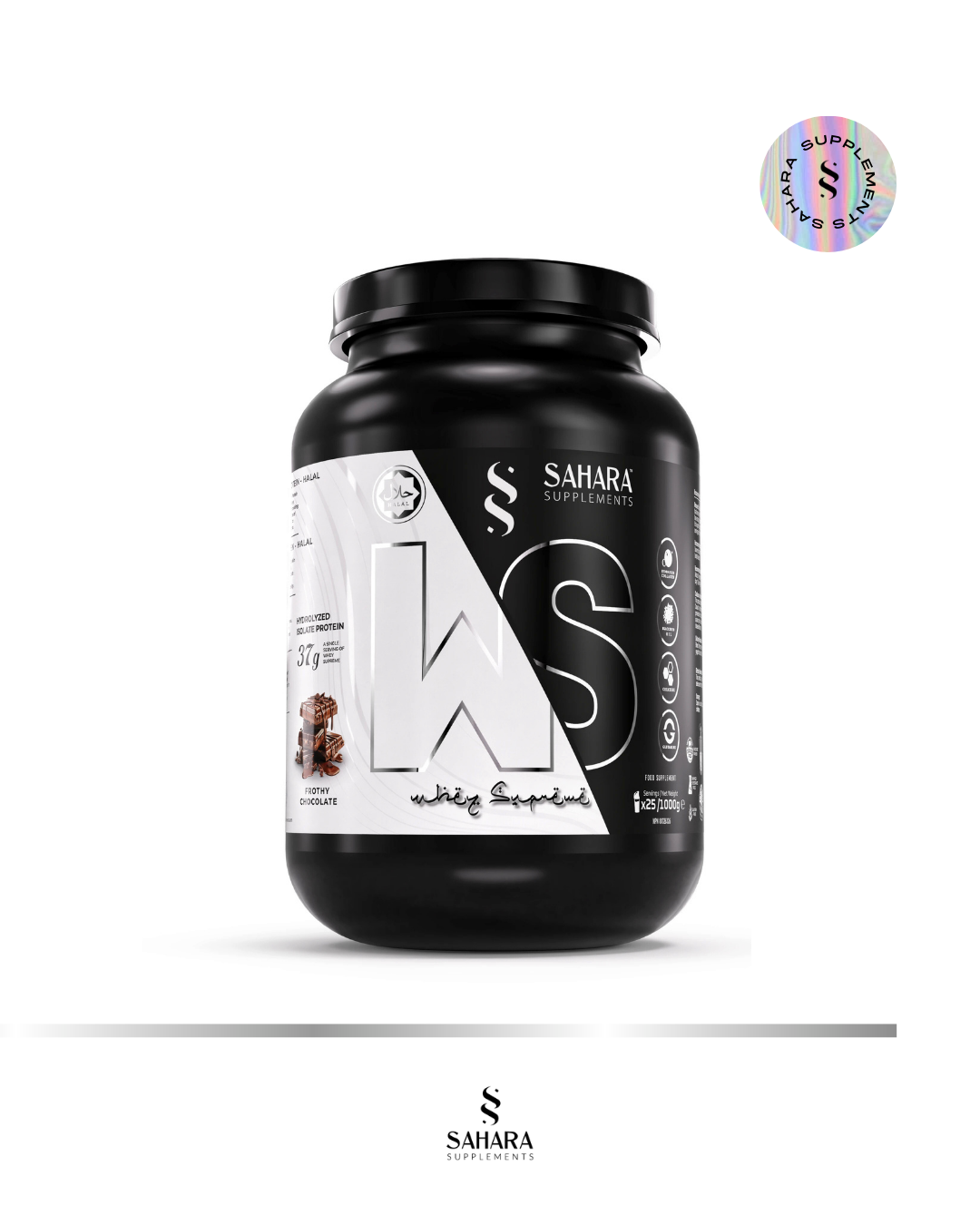
Whey Supreme is a 5-in-1 stack that simplifies supplementation:
Hydrolyzed isolate whey protein (rapid digestibility and high leucine content)
Hydrolyzed bovine collagen (type I & III support for joints/soft tissue)
Creatine monohydrate (power, strength, repeat-effort performance)
L-glutamine (recovery support and gut health)
Black seed oil (Nigella sativa; a heritage ingredient and an antioxidant powerhouse)
All halal certified, with no porcine derivatives and controls designed for serious athletes. We focus on quality, purity, and value—so one scoop can replace multiple tubs.
For our Muslim community, we take care to respect faith. For our non-Muslim community, our standards are your standards too: clean inputs, ethical sourcing, rigorous controls.
If you’re hunting for halal supplements, halal protein, halal whey, halal collagen, or any part of a halal sports nutrition routine, you don’t have to trade faith for results.
If you’re not Muslim but care about ethics, quality, and transparency, halal is a powerful signal you can trust.
If you’re a coach, trainer, or parent, halal is a way to de-risk your supplement choices with a certification layer that forces clarity on ingredients and processes.
If this resonates, start with the foundation. Sahara Whey Supreme gives you protein + collagen + creatine + glutamine + black seed oil in a single, halal-certified formula—designed for clean performance and simple compliance. It’s the straightforward way to build a faith-aligned, evidence-informed routine that works for any athlete.
Key ideas covered: halal protein, halal supplements, halal collagen, halal whey, Islamic supplements, halal fitness, halal sports nutrition—in the context of animal welfare, ethical treatment, purity, hygiene, and cross-contamination controls. If you want supplements that meet where modern ethics and performance intersect, halal is the label to learn—and Sahara is the brand to trust.

